
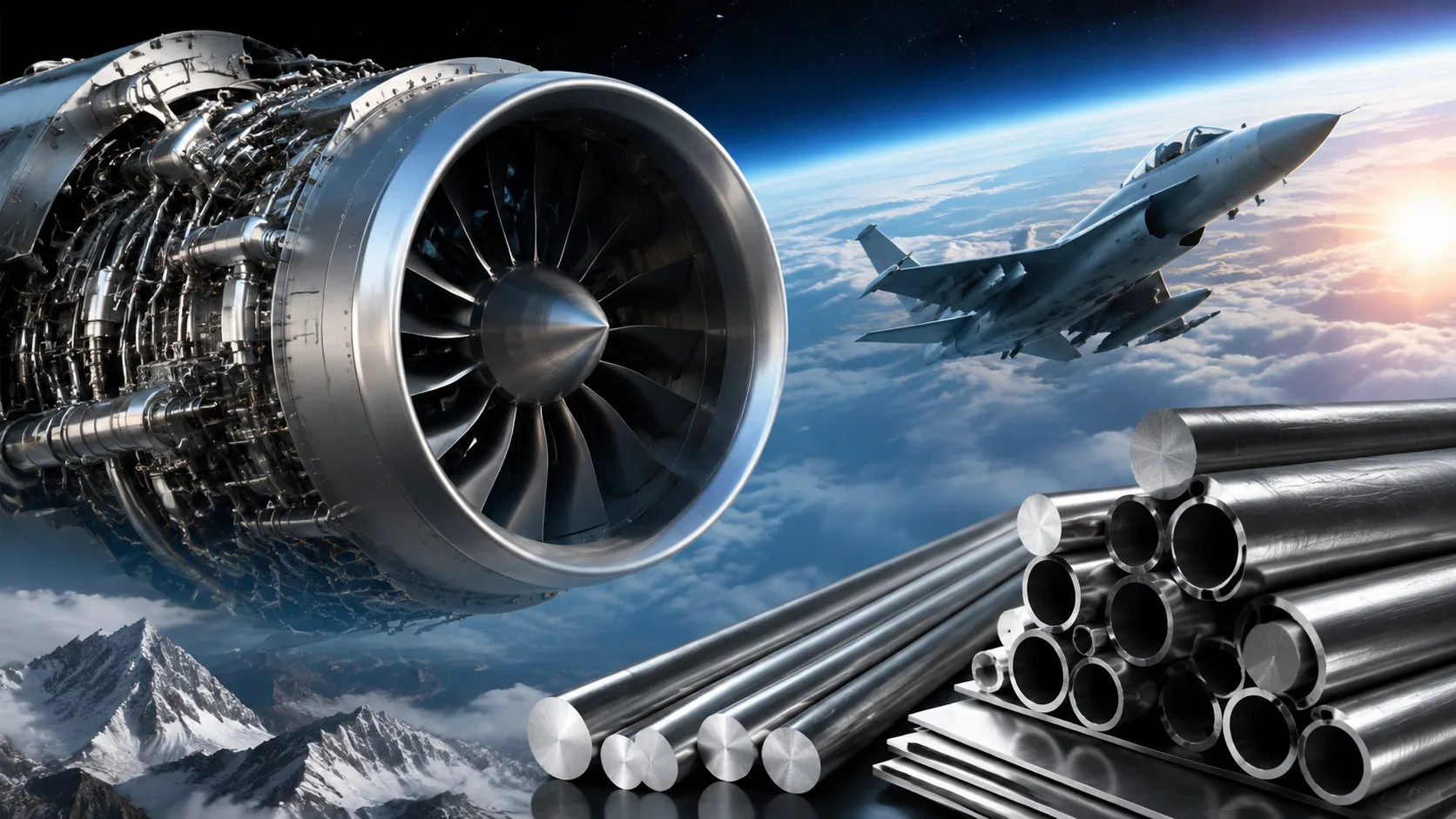
If you have ever gazed at a jetliner streaking across the sky, or felt your heart race at the sight of a rocket thundering into space, there is one name worth remembering: Inconel 718.
It does not boast, yet it is everywhere. In the very core of every modern aircraft engine, in the “heart” of every rocket bound for orbit, its presence is felt. It does not chase the highest temperature极限, but with its rare combination of high strength, excellent fatigue resistance, and good workability, it has become the most widely used “backbone” material in aero-engine applications.
Think of it as the “all‑rounder” of superalloys—not a mediocre jack‑of‑all‑trades, but a versatile performer that excels in every extreme condition.
Numbers speak volumes: over 30% by mass of critical components in modern aircraft engines are made from Inconel 718. Turbine disks, compressor disks, blades, casings, shafts, fasteners—from the compressor section through the combustor to the turbine, it is found everywhere. Without Inconel 718, humanity’s feats of flight and space exploration would not be possible.
What makes it so formidable? Today, we take you inside this “sky‑and‑earth” alloy king to uncover its hidden secrets.

A Legendary Origin: The Victory of “Balance”
The story begins in the early 1960s.
It was an era of bold visions—supersonic aircraft were moving from blueprints to reality. Turbine inlet temperatures of jet engines were rising relentlessly, demanding ever more from materials. Traditional steels and aluminium alloys had long been inadequate, leaving nickel‑based superalloys as the only viable choice.
But all existing nickel‑based superalloys faced a fatal dilemma: to gain higher temperature capability, you had to sacrifice weldability and workability. You could produce an alloy that withstands 1000°C, but if it cannot be welded or machined, it is little better than scrap. Engineers were caught in an impossible trade‑off.
At that moment, the Huntington Alloys laboratory of the International Nickel Company (INCO) made a decision that would change aviation history. Instead of racing further down the beaten path of “ever‑higher temperature limits,” they took a different approach.
Their thought was: rather than chasing an elusive “maximum temperature,” why not create an alloy with the most balanced overall performance—high enough strength, weldable, machinable, corrosion‑resistant, fatigue‑resistant—excellent in every respect?
Thus, Inconel 718 was born.
This philosophy was almost counter‑trend at the time. But history has proven it to be one of the most successful paradigm shifts in materials science. With its outstanding combination of properties, Inconel 718 was quickly adopted for turbine components, and over the following decades, it has firmly held the top spot as the most heavily consumed wrought superalloy.
Today, its Chinese equivalent is designated GH4169. It is the world’s largest‑production, most broadly applied, and most comprehensively balanced nickel‑based superalloy, accounting for over 40% of global superalloy output annually.
Core Secret: Nanoscale “3D Printing”
Why is Inconel 718 so strong? The answer lies in its microscopic world.
Let us start with its “formula”:
| Element | Content (mass %) | Function |
| Nickel (Ni) | 50–55 | Matrix element, provides structural stability |
| Chromium (Cr) | 17–21 | Oxidation and corrosion resistance |
| Iron (Fe) | Balance (approx. 18–22) | Reduces cost, improves plasticity |
| Niobium (Nb) | 4.75–5.50 | Primary strengthening element |
| Molybdenum (Mo) | 2.80–3.30 | Solid‑solution strengthening |
| Titanium (Ti) | 0.65–1.15 | Auxiliary strengthening |
| Aluminium (Al) | 0.20–0.80 | Auxiliary strengthening |
See the key? The most distinctive feature of Inconel 718 is that it uses niobium (Nb) instead of aluminium and titanium as the main strengthening element.
Most nickel‑based superalloys rely on the γ′ phase (Ni₃(Al,Ti))—a face‑centred cubic precipitate—for strengthening. But Inconel 718 takes a different path; its core strengthening phase is the γ″ phase (Ni₃Nb)—a metastable body‑centred tetragonal precipitate.
Here we encounter a very cool mechanism—precipitation hardening (also called age hardening).
Imagine this: as‑supplied Inconel 718 has all its strengthening elements uniformly “dissolved” in the nickel matrix, leaving the material relatively soft and easy to machine. Then, engineers place it in a heat‑treatment furnace and hold it at about 720°C for 8 hours.
At this point, magic happens—niobium atoms begin to “rally” within the matrix.
They migrate from all directions and, at the nanoscale, “grow” countless fine, disc‑shaped γ″ precipitates. These discs are typically only tens of nanometres in diameter and just a few nanometres thick—thousands of times thinner than a human hair.
Think of it as a “nanoscale 3D printing” operation inside the metal. With temperature and time as the “code,” engineers direct niobium atoms to “print” billions of neatly arrayed “little fortresses” within the matrix.
These “fortresses” account for a volume fraction of 12%–20%. They maintain a coherent relationship with the surrounding matrix—meaning the atomic arrangements match perfectly at the interface. This coherency generates a lattice misfit of about 2.86% at the γ″/γ boundary, creating a tremendous coherency strain‑hardening effect.
When external force tries to deform the metal, dislocations (the “defect lines” inside the material) attempting to slip are firmly blocked by these “fortresses.”
The dislocations either have to forcefully “cut” through them—requiring enormous shear stress—or go around them—consuming even more energy. Either way, deformation becomes vastly more difficult.
That is the source of Inconel 718’s extraordinary strength.
In addition to the γ″ workhorse, the alloy also contains a small amount of γ′ phase (Ni₃(Al,Ti)) for auxiliary strengthening, plus solid‑solution strengthening from molybdenum (Mo), chromium (Cr), and other elements. The superposition of multiple strengthening mechanisms creates the legend of this “alloy king.”
Performance Data: Let the Numbers Speak
With all that theory, let us bring in some hard data.
After standard solution treatment plus two‑step ageing, Inconel 718 delivers impressive room‑temperature mechanical properties:
– Tensile strength: ≥1240 MPa (up to over 1400 MPa)
– Yield strength (0.2% offset): ≥1030 MPa (up to 1240 MPa)
– Elongation: ≥12%
– Hardness: ≥35 HRC
What does 1030 MPa yield strength mean?
Ordinary construction rebar has a yield strength of only about 300–400 MPa. Inconel 718 is roughly three times stronger. In other words, a bar as thin as a chopstick made of Inconel 718 can support a load sufficient to lift a small car.
Even more impressive, this high strength is not limited to room temperature. At 650°C, Inconel 718 still maintains remarkable strength:
– High‑temperature tensile strength: ≈1000 MPa
– High‑temperature yield strength: ≈850 MPa
Consider that 650°C is roughly the operating temperature in the rear stages of a high‑pressure compressor in a jet engine. Ordinary steel would have long since turned into a “soft mess” at this temperature, but Inconel 718 remains resolute.
In creep resistance, Inconel 718 also excels:
– At 650°C / 690 MPa, rupture life ≥25 hours
– At 650°C / 550 MPa, creep elongation after 100 hours ≤0.1%
Creep is a major enemy of high‑temperature materials—under sustained heat and stress, the material can slowly “flow” like wax. Yet Inconel 718, under the demanding conditions of 650°C and 550 MPa, deforms less than one thousandth of its length over 100 hours. This stability is the foundation for aero‑engine safe operation over tens of thousands of hours.
On the low‑temperature side, Inconel 718 is equally impressive. Its service temperature extends down to –253°C (liquid‑hydrogen temperature), where it retains excellent toughness and strength without any ductile‑to‑brittle transition. From the extreme cold of liquid hydrogen to the searing heat of a jet engine, it holds steady.
Sky and Earth: The Ubiquitous “All‑Rounder”
With stable performance across a wide temperature range from –253°C to 650°C, Inconel 718 finds application in virtually every high‑end field one can imagine.
Aerospace: The Absolute Core Domain
This is the most concentrated and irreplaceable application area for Inconel 718.
In jet engines, it is used to manufacture:
– Turbine disks – bearing extreme centrifugal and thermal stresses
– Compressor disks and blades – especially in the rear stages of the high‑pressure compressor
– High‑speed rotor shafts – connecting turbine and compressor disks
– Casings – protecting and supporting the engine structure
– Fasteners – bolts, nuts, and other connecting elements

The CFM56 engine—one of the most widely used turbofan engines in the world—uses Inconel 718 for its rear‑stage compressor blades.
In the space sector, Inconel 718 also plays a major role:
– Rocket engine turbopumps
– Combustor chamber bulkheads
– Fuel injectors (used, for example, in the US Atlas rocket)
– Skins and frames of high‑speed vehicles subjected to aerodynamic heating

From aircraft to rockets, from within the atmosphere to beyond, Inconel 718 is everywhere.
Other Fields: Blooming Everywhere
Beyond aerospace, Inconel 718 enjoys broad application:
– Nuclear industry: control‑rod drive mechanisms, in‑core fastener bolts (extending service life from 2 to 10 years), main pump shaft seals
– Oil and gas: drill collars, tool joints, downhole tools – resisting corrosive media containing H₂S and CO₂
– Chemical equipment: heat exchangers, reactors – corrosion resistance more than five times that of ordinary stainless steel
– Industrial gas turbines: turbine blades, rotor disks, combustor components

In short, wherever two or more of high temperature, high pressure, high stress, and severe corrosion are present, you are likely to find Inconel 718.
The Hidden Ace: Why Is It the “All‑Rounder”?
Many might ask: there are other superalloys besides Inconel 718, and some can withstand even higher temperatures. Why has this one become the “all‑rounder”?
The answer lies in a characteristic that is often overlooked—weldability.
Most precipitation‑strengthened nickel‑based superalloys have a fatal weakness: they crack after welding. Because strengthening phases precipitate during the welding thermal cycle, leading to cracks in the heat‑affected zone. Engineers have struggled with this problem for decades.
But Inconel 718 is entirely different.
Because formation of the γ″ phase requires a dedicated ageing heat treatment, the natural ageing response during welding is very weak, so the heat‑affected zone is less prone to cracking. It can be reliably welded by TIG, electron‑beam, resistance welding, and other methods, with very low post‑weld cracking tendency.
Even better, post‑weld ageing not only does not soften the heat‑affected zone but can harden it together with the weld metal.
This characteristic has revolutionised the manufacturing of superalloy components. Large, integral structures—such as rocket engine casings and turbine disk assemblies—became feasible. Weldability means complex structures can be split into smaller parts, manufactured separately, and then joined into a whole. This greatly reduces manufacturing difficulty and cost.
Coupled with its relatively good cold and hot workability (good plasticity in the solution‑treated state, permitting cold rolling and drawing) and its moderate cost (the higher iron content reduces nickel usage), Inconel 718 has no rival in terms of overall cost‑performance.
It is not the most heat‑resistant, nor the strongest, but it is the most serviceable.
That is the true meaning of “all‑rounder.”
Not Perfect: Its Achilles’ Heel
Every material has its weaknesses, and Inconel 718 is no exception.
Its Achilles’ heel is the temperature ceiling. Prolonged exposure above 650°C causes the γ″ phase to gradually transform into the δ phase (also Ni₃Nb, but with a different crystal structure). The δ phase provides no strengthening and consumes niobium from the matrix, leading to a drop in strength. Therefore, Inconel 718 is not recommended for long‑term service above 700°C.
This means that in the forward sections of an aircraft turbine—where temperatures can exceed 1000°C—Inconel 718 cannot hold up. Those regions require single‑crystal superalloys, ceramic matrix composites, and other more “hard‑core” materials.
But in the mid‑ and rear‑turbine sections, compressor stages, casings, shafts, and other areas where temperatures are relatively lower but stresses are enormous, Inconel 718 remains the undisputed king.
A Behind‑the‑Scenes Hero, Well Deserved
Since its birth in the 1960s, Inconel 718 has traversed more than half a century. In that time, countless new materials have emerged, but none has truly dethroned it.
It does not pursue the ultimate single‑property extreme; instead, with its most balanced overall performance, it has conquered one high‑end field after another—aerospace, nuclear energy, oil, chemicals, and more. It is the “spine” of turbine disks, the “heart valve” of rocket engines, the “hard bone” of deep‑well drill strings.
Over 30% of critical aero‑engine components are made from it, and its annual production accounts for over 40% of the world’s superalloy output. Behind these numbers lies the cumulative wisdom of countless engineers and scientists over more than fifty years.
So the next time you hear the roar of an aircraft engine or see a rocket trailing a long plume of flame as it soars into the sky, remember—deep within that searing core, there is a behind‑the‑scenes hero named Inconel 718, using its nanoscale “little fortresses” to quietly safeguard humanity’s dreams of flight.
It is the all‑rounder of superalloys, the alloy king that conquers both sky and earth.
And that is the story of Inconel 718.