
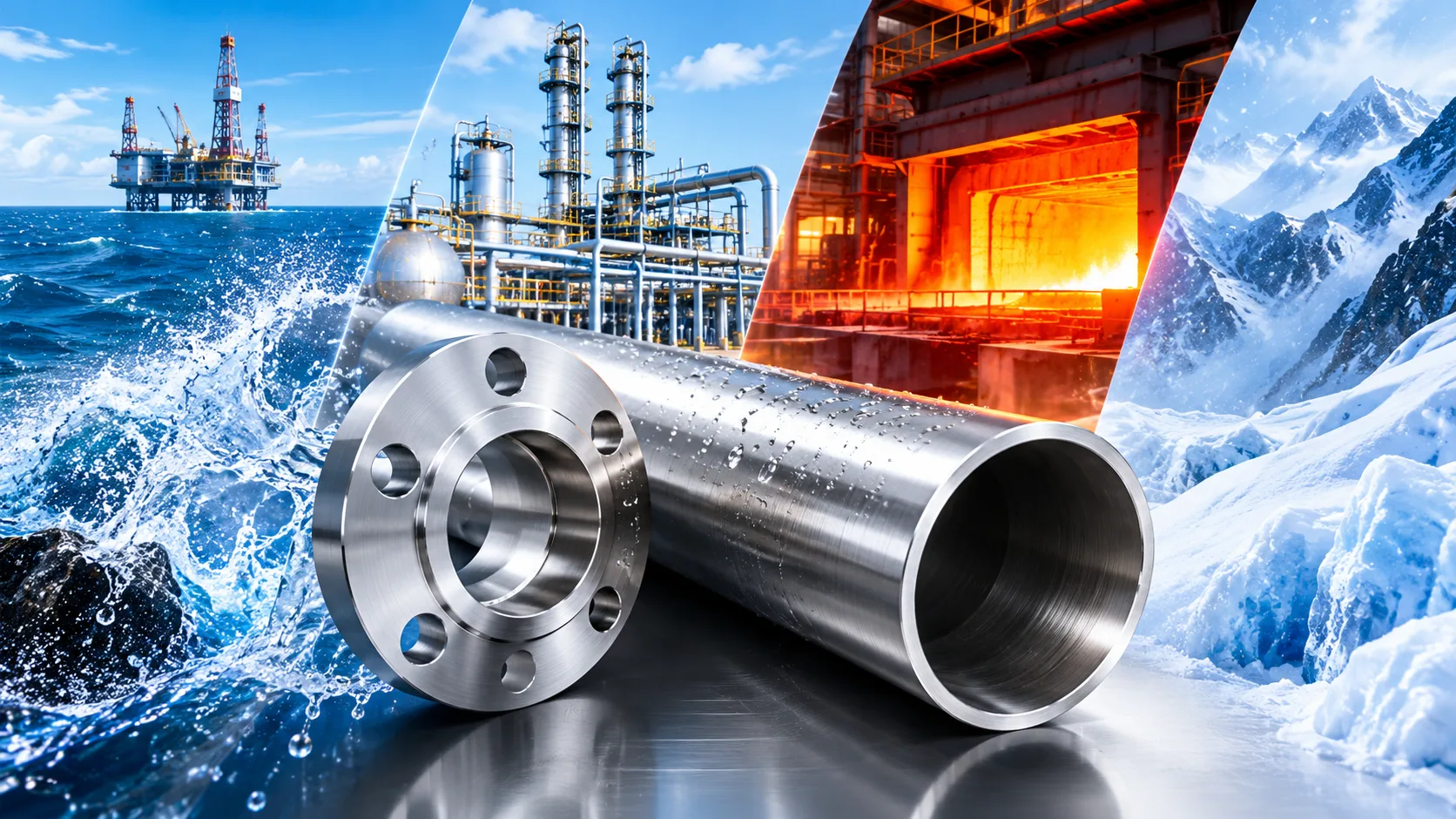
If you ask a materials engineer, “Is there a metal that can withstand both the corrosion of subsea pipelines and the high temperatures of aircraft engines?”
He will most likely fall silent for two seconds, then utter a single designation: N06625.
This name, which sounds like a code, has a more renowned alias in industry—Inconel 625. It truly is like a code, because only those who can crack its secrets truly understand what it means to be an “all-rounder.”

First, Let’s Max Out the Sense of Contrast
Imagine two scenarios.
Scenario one: In the Persian Gulf seabed, a pipeline is transporting produced water containing high concentrations of chloride ions, hydrogen sulfide, and carbon dioxide. The seawater temperature remains above 30℃ year-round, and the pipeline’s inner wall endures the scouring of high-temperature, high-pressure corrosive fluids. Here, ordinary carbon steel would be corroded through in a few months, and 316 stainless steel wouldn’t last much longer.

Scenario two: At ten thousand meters altitude, a passenger aircraft’s engine is operating at temperatures above 900℃ Inside the tail nozzle, combustion gases scour the metal’s inner wall at speeds of hundreds of meters per second, while simultaneously enduring severe thermal cycling—rapid heating during takeoff, slow cooling during cruise, and another temperature shock during descent.

These two scenarios—one on the seabed, one in the clouds; one testing corrosion resistance, one testing high-temperature resistance.
But inside them, there is a layer of metal made of the same material.
This is N06625’s “take-all” capability. It is not a specialist; it is the kind of “other people’s child” who can score an A in every subject. If there were a special forces selection in the metal world, it would probably pass underwater demolition, high-altitude parachuting, and polar survival all at once.
The Formula Is Combat Power: A Precisely Blended “Cocktail”
To understand why N06625 is so formidable, one must first look at its formula.
62% nickel + 22% chromium + 9% molybdenum + 3.7% niobium—this ratio is, in the materials world, almost a carefully blended “cocktail.” Each “spirit” has a clear role; one part less won’t do, and one part more is also wrong.
Nickel (62%) is the base spirit. It takes up the lion’s share and determines the basic flavor of the drink. Nickel forms a face-centered cubic austenitic matrix, endowing the material with comprehensive toughness from liquid nitrogen temperature to high temperatures, while providing natural immunity to chloride ion stress corrosion cracking. In other words, it ensures the drink “won’t get you drunk”—no matter how extreme the environment, the material will not suddenly become brittle and fracture.
Chromium (22%) is the oxidation-resistant layer. It is responsible for forming a dense Cr₂O₃ passivation film on the material’s surface, like putting a “protective suit” on the metal, blocking the attack of seawater, atmosphere, and oxidizing acids.
Molybdenum (9%) is the corrosion-resistance vanguard. Its atomic radius differs greatly from that of nickel; after dissolving in the nickel matrix, it produces strong lattice distortion, substantially increasing the alloy’s yield strength, creep resistance, and high-temperature stress rupture performance in the range from room temperature to 980℃ . At the same time, molybdenum is the core element for resisting pitting corrosion, crevice corrosion, and reducing acids, enabling the alloy to perform excellently in hydrochloric acid, sulfuric acid, and chloride-containing brines.
Niobium (3.7%) is the hidden “reserve move.” On one hand, it dissolves into the nickel-chromium matrix together with molybdenum, producing solid-solution strengthening and enhancing creep and fatigue resistance; on the other hand, it preferentially combines with carbon to form stable MC-type carbides, fundamentally avoiding chromium depletion at grain boundaries, so that the weld heat-affected zone maintains intergranular corrosion resistance even after multiple thermal cycles.
The division of labor among these four elements constitutes N06625’s “all-round” logic: nickel preserves toughness, chromium resists oxidation, molybdenum resists reducing corrosion, and niobium controls microstructure and strengthening.
From Liquid Nitrogen to 1093℃: It Doesn’t Pick Temperatures
Most metals have a “comfort zone.” Carbon steel fears cold—freeze it and it becomes brittle; aluminum alloy fears heat—bake it and it softens.
N06625’s comfort zone is absurdly wide.
Its strength coverage ranges from cryogenic temperatures all the way to 1093℃—note, “all the way to,” with no gap in between. What does this temperature span mean? From the liquid nitrogen environment at minus 196℃ to the 1093℃ aero-engine tail nozzle, it can maintain excellent strength and toughness.
Even more surprising is its performance at low temperatures. Studies have conducted tensile tests on N06625 from 295K (room temperature) to 77K (liquid nitrogen temperature), and the results show: the lower the temperature, the stronger it becomes, and its toughness does not decrease but instead increases. Yield strength increased from 370MPa to 550MPa , and tensile strength increased from 792MPa to 1134MPa , improvements of 46.2% and 43.2%, respectively. More notably, elongation increased from 69% to 89.4%—meaning that in extremely cold environments, it not only did not become brittle but actually became tougher.
A material simultaneously achieving “stronger” and “tougher”—this is a rather counterintuitive phenomenon in metallurgy. N06625 achieves it.
At the high-temperature end, what does 1093℃ mean? The melting point of iron is 1538℃; 1093℃ is already close to 71% of iron’s melting point. At this temperature, many metals have already begun to soften or even oxidize and spall, but N06625 still maintains usable mechanical properties. This relies precisely on the solid-solution strengthening effect of molybdenum and niobium—after these refractory metal atoms dissolve into the nickel-chromium matrix, they are like countless tiny “rebar” erected inside the metal, preventing atomic slip at high temperatures.
The “Unsinkable Battleship” in Seawater
Returning to the subsea pipeline scenario.
Seawater corrosion is a “combination punch” for metals: chloride ions attack the passivation film, causing pitting and crevice corrosion; stress corrosion cracking causes materials to suddenly fracture at stresses far below their strength; oxygen and microorganisms in seawater also accelerate uniform corrosion.
N06625’s response to this “combination punch” is: almost immune.
Its high molybdenum content (9%) gives it extremely strong resistance to chloride pitting and crevice corrosion; its high nickel content (62%) gives it resistance to chloride ion stress corrosion cracking. In marine environments, it almost never suffers pitting or crevice corrosion, and is “almost immune” to chloride ion stress corrosion cracking.
The U.S. Navy discovered the value of this material long ago. N06625 is used in submarine auxiliary propulsion motors, naval vessel exhaust systems, underwater communication cable sheaths, mooring rope wire ropes, and other critical components. In the chemical industry, its performance is equally outstanding—equipment made with N06625 can be made thinner than with other materials—because its strength is sufficiently high, wall thickness can be reduced, thereby improving heat transfer efficiency and saving weight.
Two Real Stories
No amount of theory beats looking at two solid projects.
Story one: Abu Dhabi’s subsea “purgatory”
In 2026, on Zirku Island in Abu Dhabi, UAE, the SARB produced water treatment project is underway. This is a PACKAGE5-level core project, treating “produced water” generated during oil and gas extraction—a high-temperature, high-pressure fluid containing high concentrations of chloride ions, hydrogen sulfide, and carbon dioxide.

Anhui Fukai Special Material Co., Ltd. passed the certification of the Abu Dhabi National Oil Company (ADNOC) and supplied N06625 nickel-based alloy plates for this project, used as cladding material for explosion-bonded clad plates in core equipment. Explosion-bonded clad plate is a technology that bonds a thin layer of corrosion-resistant alloy to a carbon steel base layer through explosive welding, ensuring both corrosion resistance and cost control. N06625, as the cladding layer, must directly face the high-chloride, high-sulfur, high-temperature, high-pressure corrosive environment.
Story two: The “pipeline test” of the Middle East’s largest gas field
Also in 2026, Nippon Yakin Kogyo Co., Ltd. announced that its high-corrosion-resistant nickel-based alloy NAS625 (UNS N06625) was selected for the offshore gas compression project of the world’s largest-class natural gas field in the Middle East.

The logic of this project is simple: steel pipes in offshore gas compression equipment need to serve long-term under high pressure and highly corrosive conditions, and ordinary corrosion-resistant alloys cannot handle it. N06625 was designated as the material standard due to its excellent corrosion resistance and durability. Nippon Yakin will supply NAS625 plates to overseas pipe manufacturers, which will process them into welded steel pipes and assemble them into equipment.
It is worth noting that the NAS625 composition formula given by Nippon Yakin is 62Ni-22Cr-9Mo-3.7Nb-0.2Ti-0.2Al—almost identical to the “cocktail formula” mentioned earlier. The consistency of the formula is precisely why it can be selected simultaneously by different countries and different projects.
From the Persian Gulf seabed to the Middle East natural gas field, N06625 appeared simultaneously in two world-class energy projects in the same year. And at the same time, it is still quietly working in aero-engine tail nozzles.
How Does It Do It?
Returning to the original question: By what means can one material appear simultaneously in subsea pipelines and aircraft engines?
The answer lies in that “cocktail.”
The solid-solution strengthening effect of molybdenum and niobium is the source of strength. The atomic radii of these two elements differ greatly from that of nickel; after dissolving into the nickel-chromium matrix, they produce strong lattice distortion, greatly improving the alloy’s yield strength, creep resistance, and high-temperature stress rupture performance. Moreover, this strengthening requires no heat treatment—no age hardening, no precipitation strengthening; the material possesses high strength in the solution-treated state. This means it can be conveniently welded, formed, and machined, without losing performance due to improper heat treatment processes.
Chromium and molybdenum provide corrosion resistance. Chromium builds the oxidation-resistant film, molybdenum blocks reducing acids and pitting pathways, and the two form a “dual corrosion resistance” architecture. In chloride-containing environments, molybdenum’s role is especially critical—it significantly enhances the alloy’s resistance to pitting and crevice corrosion.
The nickel matrix ensures toughness. Nickel forms a face-centered cubic austenitic matrix; this crystal structure inherently possesses excellent toughness and plasticity. From liquid nitrogen temperature to 1093℃, the nickel matrix always maintains good toughness without ductile-brittle transition.
Niobium plays the role of “welding protector.” During welding, niobium preferentially combines with carbon, preventing chromium carbides from precipitating at grain boundaries, thereby avoiding intergranular corrosion susceptibility in the weld heat-affected zone. This allows N06625 to maintain excellent corrosion resistance in the as-welded condition—an extremely important characteristic for a pipeline material requiring extensive welding.
In Closing
N06625 is not the cheapest metal, nor the lightest metal. But when it comes to “being able to do everything,” it has almost no rival.
Subsea pipelines need it because it fears no chloride ions; aircraft engines need it because it fears no high temperatures; chemical plants need it because it fears no acids or bases; nuclear reactors need it because it fears no radiation or high-temperature water.
It is like a special forces soldier: what others can do, it can do; what others cannot do, it can also do.
And the underlying logic of this capability is nothing more than a precise formula—62% nickel, 22% chromium, 9% molybdenum, 3.7% niobium—each element performing its own role, jointly supporting a materials legend spanning from the seabed to the clouds.
Next time you fly, you can think about it: in some corner of the engine, there may be a layer of N06625 holding fast at 1093℃. And at the same time, on the seabed of the Persian Gulf, another N06625 of the same formula is quietly working in a high-chloride, high-sulfur corrosive environment.
One metal, two extreme worlds. This is N06625’s “take-all” philosophy.