The Quick-Dry Clothing You Wear May Be Related to a “Super Stainless Steel”
Have you ever thought that the quick-dry T-shirt, yoga pants, or sports bra you wear might have a hidden connection to a special stainless steel?
This is not a joke. The raw materials for synthetic fibers—polyester, nylon, spandex—can mostly be traced back to the same intermediate: urea. Urea is not only the mainstay of agricultural fertilizers, but also a core raw material for chemical fibers, plastics, melamine, and other chemical products. It can be said that without urea, there would be no modern textile industry.

But today we are not talking about urea itself, but about the equipment needed to produce urea—and a special steel used in that equipment.
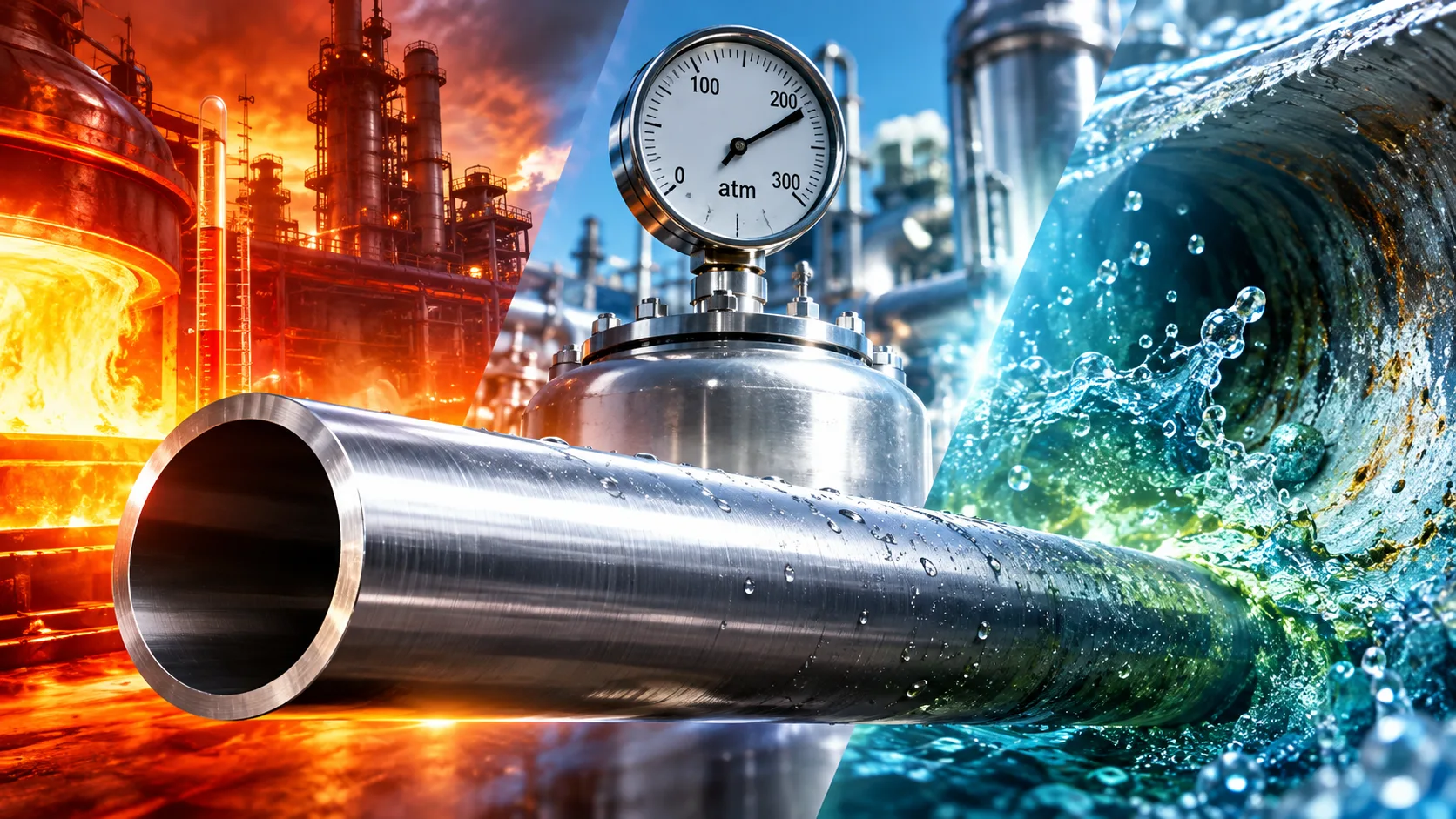
Because in the urea production process, the operating environment of the equipment can be summed up in four words: hell mode.
The “Pressure Cooker” of Industry: 180°C + 250 atm + Strong Corrosion
Let us first reconstruct the scene of urea synthesis.
The core reaction of urea synthesis takes place in a high-pressure synthesis tower, where ammonia and carbon dioxide react under high temperature and high pressure to form ammonium carbamate, which is then dehydrated to form urea. It sounds like a line from a middle-school chemistry textbook, but the actual operating conditions are extremely harsh.
In this reaction environment, the temperature is as high as 180–210°C, the pressure reaches 14–25 MPa (about 140–250 atm), and the medium is ammonium carbamate solution—a highly corrosive intermediate product.
What does 250 atm mean? The working pressure of a household pressure cooker is about 1.8 atm, and industrial high-pressure reactors are usually between 10 and 30 atm. The pressure in a urea synthesis tower is equivalent to pressing the entire weight of a small car onto an area the size of a coin.
And ammonium carbamate solution, at high temperature, is brutally corrosive to metals. It reacts with iron, chromium, and nickel in stainless steel, causing uniform corrosion, intergranular corrosion, selective corrosion, pitting corrosion, and many other failure modes.
In this environment, ordinary 304 stainless steel is basically as flimsy as paper. 316L stainless steel is not much better—its corrosion resistance quickly becomes inadequate in urea media. Even when upgraded to 316LMod (a modified urea-grade 316L), its service life in core equipment such as synthesis towers and strippers is still limited.
This is why urea plants around the world are looking for a steel that can truly withstand this “hell mode.”
725Ln: Born for Urea, Built for Extreme Conditions
The answer is 725Ln.
You may not have heard of this grade, but in the special steel circle it has a more intuitive nickname—“25-22-2,” referring to its content of about 25% chromium, 22% nickel, and 2% molybdenum. Its international designations are UNS S31050 (American standard), EN 1.4466 (European standard), X1CrNiMoN25-22-2, and in China it corresponds to 022Cr25Ni22Mo2N.
The birth of 725Ln was itself the product of a crisis.
In the 1970s, global fertilizer demand soared. Process licensors such as Stamicarbon and Snamprogetti developed the total recycle stripping process to increase urea output, pushing synthesis tower temperatures to around 200°C. The original 316LMod rapidly corroded and perforated under these extreme conditions, even causing plant shutdown accidents.
Metallurgists at the Swedish company Avesta were called in to respond. They found that traditional 310S (25Cr-20Ni), although resistant to high temperatures, easily precipitated harmful phases in wet corrosive environments. Thus a bold formula was born: add nitrogen, increase nickel content, and reduce carbon to an extremely low level—and 725Ln came into being.
What was the result? It quickly became the standard configuration for tube bundles in urea strippers worldwide, monopolizing the high-end market for decades.
“Extreme Purity”: The Formulation Philosophy of 725Ln
The core design idea of 725Ln can be summed up in four words: extreme purity.
Let us look at its full chemical composition: carbon (C) ≤ 0.03%, silicon (Si) ≤ 0.40%, manganese (Mn) ≤ 2.00%, phosphorus (P) ≤ 0.03%, sulfur (S) ≤ 0.015%, chromium (Cr) 24.0–26.0%, nickel (Ni) 21.0–23.0%, molybdenum (Mo) 2.0–3.0%, nitrogen (N) 0.10–0.16%.
Behind the content of every element is an extremely clear engineering logic.

Carbon: Pressed to the Limit, Sealing Off the Path of Intergranular Corrosion
Carbon is the “culprit” behind intergranular corrosion in stainless steel. When the material is slowly cooled or held for a long time in the 500–800°C range, carbon atoms diffuse toward grain boundaries and combine with chromium to precipitate chromium-rich carbides (Cr₂₃C₆), forming a “chromium-depleted zone” about 1–2 μm wide around the grain boundaries—chromium content falls below the 12% passivation threshold, and corrosion begins there.
725Ln presses carbon down to ≤ 0.03%, a value below the room-temperature solubility limit of carbon in austenitic stainless steel, fundamentally sealing off the precipitation path of chromium carbide. Combined with extremely low impurity control of sulfur ≤ 0.015% and phosphorus ≤ 0.03%, it minimizes the risk of grain-boundary segregation and inclusion-induced corrosion.
Chromium and Nickel: Building the Corrosion-Resistant Skeleton, Locking in the Austenitic Structure
Chromium is given at 24–26%, maintaining a dense Cr₂O₃-rich passive film in oxidizing ammonium carbamate solution. Nickel is raised to 21–23%, ensuring that the ferrite content in the solution-treated state is below 0.5%, obtaining a fully austenitic structure—this is a mandatory index for urea-grade materials, because the presence of any δ ferrite will induce σ-phase embrittlement and selective corrosion during welding and thermal cycling.
Molybdenum and Nitrogen: The Finishing Touch
Molybdenum content of 2.0–3.0% is the key that distinguishes 725Ln from ordinary 310S. 310S alone will still undergo pitting in media containing trace chloride ions and ammonium carbamate hydrolysis products. The addition of molybdenum raises the pitting resistance equivalent number PREN (= Cr + 3.3Mo + 16N) to ≥ 33,crossing the safety line for urea media. Nitrogen content of 0.10–0.16% undertakes a dual task: on the one hand, through interstitial solid-solution strengthening, it raises the yield strength from 205 MPa for pure 310S to the 250 MPa level; on the other hand, it stabilizes austenite, allowing carbon to be pressed to an extremely low level without the appearance of ferrite.
Performance Data: No Empty Talk
The mechanical properties of 725Ln in the solution-treated condition (held at 1140–1180°C and then water quenched):
- Tensile strength: ≥ 540 MPa
- Yield strength (Rp0.2): ≥ 250 MPa
- Elongation after fracture: ≥ 40%
- Reduction of area: ≥ 50%
- Hardness: ≤ 220 HB
- Room-temperature Charpy V-notch impact: ≥ 120 J/cm²
The continuous service temperature is about 550°C, and at urea synthesis temperatures (200°C) its stiffness is more than sufficient. However, it should be noted that 725Ln is not essentially a heat-resistant steel; its long-term oxidation resistance upper limit is about 800°C, and it is not used for heated parts inside furnaces.
More critical than mechanical properties is the verification of corrosion resistance. Urea-grade materials must pass the Huey test—the specimen is boiled continuously in 65% boiling nitric acid for 5 cycles, each lasting 48 hours. The average corrosion rate of 725Ln is required to be controlled at ≤ 1.6 μm/48 h (or ≤ 65 mg/dm²·h) to qualify as urea grade. This stringent acceptance standard is the hard threshold that distinguishes ordinary stainless steel from truly urea-grade stainless steel.
Which “Battlefields” Does It Stand On?
The core battlefield of 725Ln is the high-pressure loop of urea production equipment. Specifically, this includes: stripper tubes and distributor tubes of carbon dioxide strippers, synthesis tower liners, ammonium carbamate condensers, high-pressure piping, valves, and fittings. These components directly contact high-temperature, high-pressure ammonium carbamate solution, making them the most severely corroded areas and the locations with the highest equipment failure risk.
But it does not only play a role in urea plants.With its outstanding resistance to pitting, intergranular corrosion, and stress corrosion, 725Ln is also widely used in other strongly corrosive scenarios:
Wet-process phosphoric acid plants: phosphoric acid production involves high-temperature phosphoric acid and corrosive environments containing fluoride and chloride impurities. With a PREN value above 33, 725Ln can effectively resist pitting and crevice corrosion.

Sulfuric acid reactors: in dilute sulfuric acid and medium-concentration sulfuric acid media, the corrosion resistance of 725Ln is significantly better than that of 316L stainless steel.
Seawater desulfurization equipment and flue gas denitrification components: in power plant environmental protection systems, seawater and flue gas condensate contain high concentrations of chloride ions, and ordinary stainless steel is highly prone to pitting and stress corrosion cracking. The high chromium, molybdenum, and nitrogen formula of 725Ln can maintain a stable passive film in such chloride-containing environments.

Three Questions for Material Selection: Does Your Operating Condition Need 725Ln?
Not all stainless steel equipment needs 725Ln. The price of this special steel is far higher than that of ordinary stainless steel, so selection requires rational judgment. The following three questions can help you quickly establish a basic understanding:
First question: Does the medium contain ammonium carbamate?
Ammonium carbamate is an intermediate product of urea synthesis and one of the most corrosive media. If your equipment contacts ammonium carbamate solution in the high-pressure loop of urea synthesis, then 725Ln is almost a must. Under this scenario, 316L has an extremely short service life, while 725Ln is a standard configuration verified by decades of industrial practice.
Second question: Is the temperature above 150°C?
150°C is a key dividing line. Below this temperature, ordinary urea-grade stainless steels such as 316L Mod can still cope. But once the temperature exceeds 150°C, the corrosion rate accelerates significantly, and the attack of ammonium carbamate on stainless steel changes from controllable to dangerous. The design operating condition of 725Ln is precisely the 180–210°C range.
Third question: Is the pressure above 10 MPa?
10 MPa (about 100 atm) is another key threshold. Above this pressure, the requirements for equipment wall thickness, sealing, and material strength all increase substantially. 725Ln has a tensile strength of ≥ 540 MPa and a yield strength of ≥ 250 MPa, providing sufficient structural safety in high-pressure equipment, while its fully austenitic structure ensures toughness and resistance to brittle fracture under high pressure.
If the answer to all three questions is “yes,” then 725Ln is almost the only solution.
If only one or two of the conditions are met, more economical options such as 316L Mod or 724L can be considered, but detailed corrosion assessment and life calculation are required.
Final Words
Returning to the cold fact at the beginning: the raw material for the synthetic fiber clothing you wear is urea, and the equipment used to produce it may very well use 725Ln, a special stainless steel.
This is the charm of modern industry—you would never imagine that behind the birth of a quick-dry shirt lies an extreme challenge in materials science. The high temperature of 180°C, the pressure of 250 atm, and the strongly corrosive ammonium carbamate solution—conditions that seem completely unrelated to daily life—are precisely the “daily routine” that 725Ln faces every day.
And this “daily routine” was polished bit by bit by Avesta’s metallurgists half a century ago, through the extreme purity of the formula and the exquisite balance of composition.
The progress of materials has always been like this: you cannot see it, but it changes every corner of your life.