
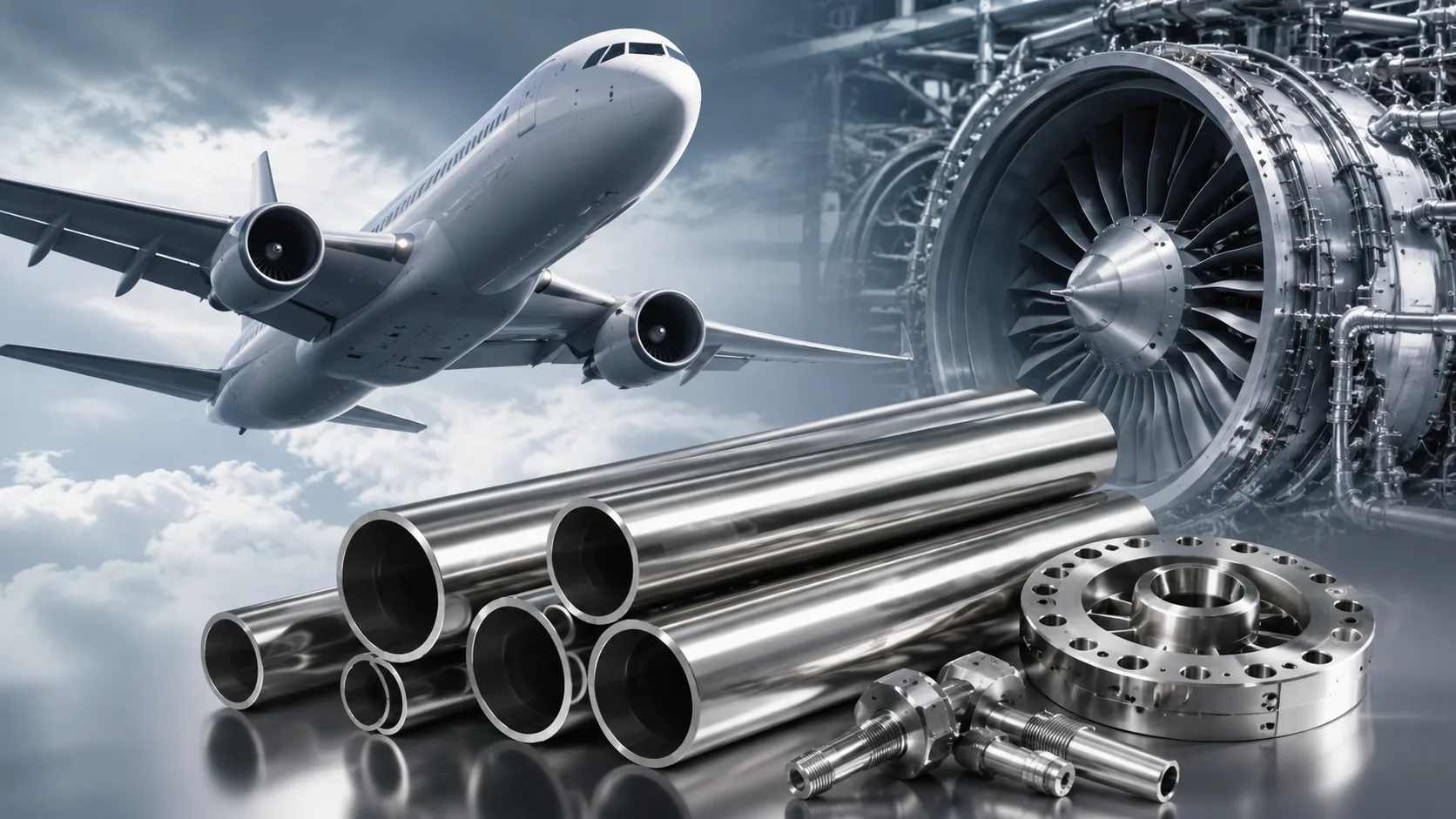
The wing beams of the Boeing 737 and the canopy latches of the F-15 fighter—both rely on this material to hold up.
From Kitchen Knife to Fighter Jet – How Far Apart Are They?
Have you ever wondered: what does the stainless steel kitchen knife you use to chop vegetables have in common with a Boeing 737 cruising at Mach 0.8 at 10,000 meters?
The answer might surprise you: both rely on stainless steel.
But don’t be mistaken. The 304 stainless steel in your kitchen knife and the “super stainless” hidden inside Boeing wings are, despite sharing the name “stainless steel,” fundamentally different—roughly the gap between a bicycle and a Formula 1 race car.
304 stainless steel has a tensile strength of about 515 MPa. For a direct comparison: a piece the size of a fingernail can withstand roughly 5 metric tons of tensile force. Sounds decent? What if I told you there is a stainless steel that, from the same fingernail-sized section, can handle nearly 15 metric tons—enough to hoist an adult African elephant? Would that sound like something out of a sci-fi movie?
That’s right—I’m talking about 15-5PH precipitation-hardening stainless steel.
This material reaches a maximum tensile strength of up to 1520 MPa. It can fly—used in the wing beams of the Boeing 737-600, the main landing gear steel pins of the Boeing 767, and the canopy latches of the F-15 fighter—and it can dive deep, serving in critical fasteners for marine engineering.
Able to go airborne and underwater, your kitchen knife, compared to it, is indeed just a toy.
So the question is: what exactly is 15-5PH, and what makes it so strong?
Identity Card – The “Special Forces” of the Stainless Steel Family
Here is a proper “ID card”:
– Grade: 15-5PH (UNS S15500)
– Chinese equivalent: 05Cr15Ni5Cu4Nb
– ASTM equivalent: XM-12
– European equivalent: 1.4545 / X5CrNiCu15-5
– Material type: Martensitic precipitation-hardening stainless steel
– Density: approx. 7.75–7.78 g/cm³
– Elastic modulus: approx. 197 GPa
– Maximum service temperature: 315°C continuous, up to 480°C for short periods
Now, you might be overwhelmed by numbers and letters. Let’s translate that into plain language.
The name 15-5PH itself reveals a lot: “15” stands for about 15% chromium, “5” for about 5% nickel, and “PH” is the abbreviation for Precipitation Hardening—its core “superpower.”
It belongs to the martensitic precipitation-hardening stainless steel family. What characterises this family? Simply put: it can be as hard as martensitic stainless steel and as corrosion-resistant as austenitic stainless steel. Traditional martensitic steels (e.g., 420 series) have high strength but poor corrosion resistance; traditional austenitic steels (e.g., 304) have good corrosion resistance but insufficient strength. 15-5PH sits perfectly in between—strength close to tool steel, corrosion resistance close to 304.
But what makes 15-5PH most legendary isn’t just its performance—it’s its origin.

The Birth of an “Upgrade”: 17-4PH’s Weakness and 15-5PH’s Comeback
To understand 15-5PH, you first need to know its “big brother”—17-4PH.
17-4PH (UNS S17400) is one of the most famous grades in the precipitation-hardening family, introduced in the late 1940s. With high strength, good corrosion resistance, and relatively low cost, it quickly found wide use in aerospace, chemical, and nuclear industries.
But 17-4PH has a fatal flaw: insufficient transverse toughness.
What does that mean? In a steel product, toughness along the rolling direction (longitudinal) is good; but perpendicular to it (transverse), toughness drops drastically—about one‑third of the longitudinal value. This is especially problematic in large-section forgings or weld heat-affected zones, where the material tends to suffer brittle fracture in the transverse direction—absolutely unacceptable for aircraft structural parts.
So, 15-5PH was born.
In the 1960s, ARMCO Inc. carried out a precise “surgical upgrade” on 17-4PH. How? They reduced chromium and copper, increased nickel, cut sulfur content to less than half that of 17-4PH, and introduced niobium (Nb) for stabilisation. These few moves completely resolved the issues of poor transverse toughness and anisotropy in large forgings.
The results?
– 17-4PH transverse Charpy impact toughness: about 8–15 J
– 15-5PH: jumps to 35–50 J
– Fracture toughness K_IC (T‑L): from 20–40 MPa·m^½ to 70–100 MPa·m^½
That’s not an improvement—it’s a transformation.
15-5PH thus became the first choice to replace 17-4PH in aerospace load‑bearing structures, and the standard for oil‑and‑gas valve stems and nuclear auxiliary parts that demand both high strength and resistance to brittle fracture.
Composition Decoded – The Precise Coordination of Five “Elemental Warriors”
Why is 15-5PH so strong? The answer lies in its chemical composition.
Chromium (Cr): 14.0%–15.5% – the “shield” for corrosion resistance
Chromium is the foundation of stainless steel’s corrosion resistance. It forms a dense chromium oxide passive film on the surface, blocking oxygen and corrosive media. The Cr content of 15-5PH is kept at 14%–15.5%—higher would precipitate harmful δ‑ferrite, lower would compromise corrosion resistance. This level ensures corrosion resistance comparable to 304, far exceeding ordinary martensitic stainless steels.
Nickel (Ni): 3.5%–5.5% – the “architect” of martensitic structure
Nickel balances the phase diagram. It stabilises austenite at high temperature, which upon quenching transforms fully into low‑carbon lath martensite. Martensite provides the basic strength framework—without it, subsequent strengthening would be impossible.
Copper (Cu): 2.5%–4.5% – the “engine” of precipitation strengthening
Copper is the most critical strengthening element. During solution treatment, copper dissolves substantially in the matrix; during ageing (480–620°C), supersaturated copper atoms precipitate as nanoscale ε‑copper‑rich phases (ε‑Cu). These nanoparticles disperse within and at the boundaries of martensitic laths, strongly impeding dislocation motion and producing a huge precipitation-hardening increment—hence the name “PH” (Precipitation Hardening).
Niobium (Nb): 0.15%–0.45% – the “gatekeeper” for grain refinement
Niobium is the smart addition that sets 15-5PH apart from ordinary martensitic steels. It forms fine, thermally stable Nb(C,N) particles that pin austenite grain boundaries, effectively suppressing grain growth during high‑temperature solution treatment or forging. Fine grains not only improve toughness but also ensure structural uniformity. At the same time, niobium fixes carbon, reducing sensitisation due to M₂₃C₆ carbide precipitation.
Low impurity control (C ≤ 0.07%, S ≤ 0.030%) – the “insurance” for toughness
Carbon is kept low mainly to reduce chromium carbide precipitation, ensuring corrosion resistance in weld heat‑affected zones and avoiding weld cracking or toughness loss. Sulfur is reduced to less than half that of 17‑4PH—low sulfur means fewer elongated MnS inclusions, which were exactly the culprits for crack initiation and the drastic drop in transverse toughness in 17‑4PH large sections.
These five elements, each with its own role, work in precise synergy to deliver the all‑round performance of 15‑5PH.
The “Transformer” Magic of Heat Treatment
If composition is 15‑5PH’s “genetics,” then heat treatment is its “spell”.
The same 15‑5PH material, through different heat treatment routes, can take on completely different “forms”—with strength adjustable from 930 MPa up to 1520 MPa. Think of Optimus Prime in Transformers—same robot, different modes, vastly different combat capabilities.
Step 1: Solution treatment (Condition A)
Hold at 1038–1065°C, then cool rapidly (air for thin sections, oil or water quench for thick sections).
At this point, the alloy is in a metastable lath martensitic state with a small amount of retained austenite. Hardness is low (≤32 HRC, ≤363 HB), and ductility is good, facilitating machining or cold forming.
In short: first soften it for processing.
Step 2: Ageing treatment (H‑series)
Heat the solution‑treated material to 482–621°C, hold for 1–4 hours, then air cool. During this stage, ε‑copper phases precipitate at the nanoscale from the martensitic matrix, producing strong precipitation strengthening.
Here’s the key: different ageing temperatures and times yield distinctly different properties:
| Condition | Ageing Cycle | Tensile Strength (MPa) | Yield Strength (MPa) | Hardness (HRC) | Elongation |
| H900 | 482°C × 1h | ≥1310 | ≥1170 | 40–47 | ≥10% |
| H925 | 496°C × 4h | ≥1170 | ≥1070 | 38–45 | ≥10% |
| H1025 | 552°C × 4h | ≥1070 | ≥1000 | 34–42 | ≥12% |
| H1075 | 580°C × 4h | ≥1000 | ≥860 | 31–38 | ≥13% |
| H1100 | 593°C × 4h | ≥965 | ≥795 | 30–37 | ≥14% |
| H1150 | 621°C × 4h | ≥930 | ≥725 | 28–37 | ≥16% |
See?
The same 15‑5PH, in H900 condition, shows tensile strength above 1310 MPa and hardness 40–47 HRC; while in H1150 condition, strength drops to 930 MPa, but elongation improves to over 16%, and impact toughness increases substantially.
Ultra‑high strength or high toughness? The engineer decides—no need to change materials, just change the “heat treatment spell.”
Moreover, 15‑5PH exhibits ageing distortion of less than 0.05%, making it ideal for precision parts that are age‑hardened last—machine the complex shape first, then heat‑treat to final strength with minimal dimensional change.
This “soft‑first, hard‑later” process path is one of 15‑5PH’s most appealing engineering characteristics.
“Combat Power” Comparison: 304 vs. 15‑5PH
Numbers alone may not be intuitive. Let’s make a direct “combat power” comparison:
304 stainless steel (your kitchen knife)
– Tensile strength: ~515 MPa
– Yield strength: ~205 MPa
– Hardness: ~HRB 90 (~HRC 8)
– Corrosion resistance: ★★★★★ (excellent)
– Applications: kitchenware, decoration, piping
– Can it fly? ❌ No—strength is too low.
15‑5PH (H900 condition)
– Tensile strength: ≥1310 MPa
– Yield strength: ≥1170 MPa
– Hardness: HRC 40–47
– Corrosion resistance: ★★★★ (comparable to 304)
– Applications: Boeing wing beams, F‑15 canopy latches, landing‑gear components
– Can it fly? ✅ Yes—it’s a workhorse.
How big is the gap?
– Strength: 15‑5PH is more than 2.5 times stronger than 304.
– Hardness: 15‑5PH (HRC 40–47) is over 5 times harder than 304 (≈HRC 8).
– Load‑bearing capacity: for the same cross‑section, 15‑5PH can carry 2.5 times the load.
A more vivid analogy:
A fingernail‑sized piece of 304 stainless steel can withstand about 5 metric tons of tension. The same size of 15‑5PH (H900) can withstand over 13 metric tons—enough to hoist an adult African elephant.
That’s the difference between “super stainless” and “ordinary stainless.”
An All‑Rounder That Goes Sky‑High and Sea‑Deep
Thanks to its combination of “high strength + corrosion resistance + dimensional stability,” 15‑5PH has become a critical material for demanding environments. Let’s look at some of its major roles:
Boeing 737‑600: Wing beams
The wing beams of the Boeing 737‑600 are made of 15‑5PH. Wing beams are among the most important load‑bearing structures, carrying bending and torsional loads from the entire wing. 15‑5PH’s high strength lets designers reduce structural weight while maintaining safety—and in aviation, weight reduction is everything.

Boeing 767: Main landing‑gear forward‑axle‑carrier steel pins
The steel pins for the main landing‑gear forward‑axle carriers of the Boeing 767 are also made of 15‑5PH. Landing gear absorbs huge impact loads during takeoff and landing—a pin failure would cripple the gear. Here, 15‑5PH simultaneously handles high strength and corrosion resistance—withstanding both landing shocks and attack from runway de‑icing salts and moisture.

F‑15 fighter: Canopy latches, high‑strength bolts, springs
The US F‑15 Eagle uses 15‑5PH extensively to replace traditional high‑strength alloy steels. Specific parts include canopy latches, high‑strength bolts, springs, and various fittings.
The cockpit canopy latch must securely lock the canopy under high‑speed aerodynamic loads and pressure differentials, while also reliably releasing for pilot ejection in emergencies. 15‑5PH provides both adequate strength and reliable toughness—no brittle failure at critical moments.

More applications:
– Engine parts: compressor discs, blades, fasteners—stable performance up to ~300°C.
– Nuclear reactor components: pump shafts, instrument nozzles in non‑core areas—superior resistance to radiation‑induced embrittlement over ordinary stainless steels.
– Marine engineering fasteners: reliable in marine atmospheres and salt‑spray environments.
– High‑strength transmission parts: gears, shafts, mould inserts—wear‑resistant and rust‑proof.
– Surgical instruments: high‑strength forceps, orthopaedic tools—minimal dimensional change after heat treatment.
In one sentence: from passenger jets at 10,000 metres to deep‑sea equipment, 15‑5PH is everywhere.
The Ultimate Showdown with 17‑4PH: Why Does 15‑5PH Win?
Since 17‑4PH is already so strong, why create 15‑5PH? Let’s look at this “brotherly duel”:
| Property | 17‑4PH | 15‑5PH |
| Transverse Charpy impact toughness | 8–15 J | 35–50 J |
| Fracture toughness K_IC (T‑L) | 20–40 MPa·m^½ | 70–100 MPa·m^½ |
| Anisotropy | Significant | Nearly eliminated |
| Weld HAZ toughness | Insufficient | Excellent |
| Large‑section performance | Non‑uniform | Uniform |
| Weldability | Good | Even better |
15‑5PH’s transverse toughness is 3–4 times that of 17‑4PH, and its fracture toughness is 2–3 times higher. This is not a minor improvement—it’s a qualitative leap.
15‑5PH isn’t just a replacement for 17‑4PH—it’s 17‑4PH’s “complete form.”
Why Is It Called a “Super Stainless Steel”?
Back to the original question: just how strong is 15‑5PH?
On strength: After ageing, tensile strength reaches 1300–1500 MPa, comparable to medium‑carbon alloy steels. At H900, ≥1310 MPa is enough to carry the full load of a Boeing wing.
On corrosion resistance: Corrosion performance is on par with 304 stainless, far exceeding ordinary martensitic steels—reliable in marine atmospheres, weak acids, and salt spray.
On toughness: Transverse Charpy impact toughness of 35–50 J—3 to 4 times that of 17‑4PH—meaning it won’t suffer brittle failure at critical moments.
On adjustability: Through different heat treatments, strength can be tailored from 930 MPa to 1520 MPa—one material, multiple needs.
On precision: Ageing distortion below 0.05%—machine complex shapes first, then heat‑treat to final strength with almost no dimensional change.
High strength, corrosion resistance, good toughness, adjustability, and precision—these five attributes appearing simultaneously in one material are extremely rare in materials science.
That’s why 15‑5PH can fly and dive.
That’s why the Boeing 737, Boeing 767, and F‑15 all rely on it.
That’s why your kitchen’s 304 stainless steel is indeed just a toy by comparison.
The Invisible Superhero
Next time you board a Boeing 737 and accelerate down the runway, take a moment to think—beneath your feet, inside the wing, there is a material silently bearing tens of tons of load.
It is unobtrusive, unassuming, and most people will never know its name.
But it is precisely these “invisible superheroes” that uphold the backbone of modern aviation.
15‑5PH—a “super stainless steel” that can go to the skies and dive to the deep sea.
Compared to it, your kitchen knife is indeed just a toy.