
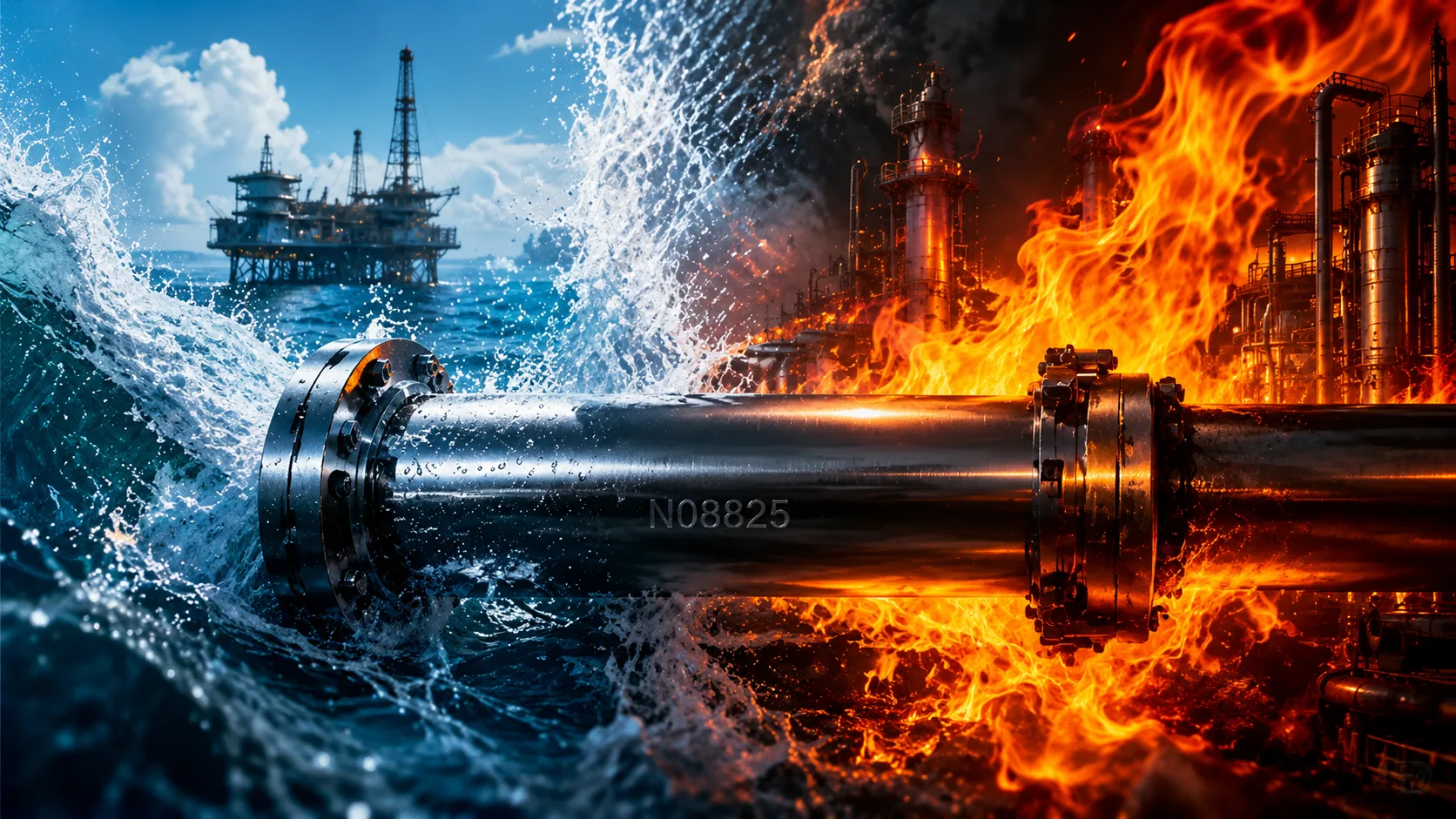
The Double Whammy: A Scenario That Makes Engineers Lose Sleep
Picture this –
A pipe. Its inner wall is exposed to high-temperature, high-pressure acidic media at over 200°C, while its outer wall is perpetually bathed in cold seawater, suffering salt-spray corrosion. The inner surface must withstand chemical attack from sulfuric acid; the outer surface must fend off electrochemical assault from chlorides.
Where is this?
Seawater pipelines on oil and gas platforms.
Or another scenario –
A heat exchanger, with boiling sulfuric acid solution (over 100°C) on one side and ambient seawater for cooling on the other. The inner and outer walls of the heat exchange tubes endure entirely different corrosive challenges – acid resistance inside, salt resistance outside.
Ordinary materials simply can’t handle it.
Use 304 stainless steel? The inner wall gets pitted and perforated by sulfuric acid in just a few days. Use 316L? In high-temperature chloride environments, stress corrosion cracking can cause brittle fracture within “hours or even minutes.” Use carbon steel? Sorry, in seawater it behaves like a nail soaking in vinegar.
On one side, salt corrosion from seawater; on the other, the scorch of “flame” – a true inferno and ice.
N08825 is the all-rounder born for exactly this kind of “between a rock and a hard place” scenario.
Born in the 1950s as the “Sulfuric Acid Terminator”
The story of N08825 begins in the 1950s.
At that time, the chemical industry faced a thorny problem – sulfuric acid corrosion. Sulfuric acid is the mother of industrial chemicals, but the equipment used to produce and store it suffered terribly from corrosion. Ordinary stainless steels were “powerless” against sulfuric acid, while more expensive nickel-based alloys were too costly.
In the 1950s, the research laboratory of the Huntington Alloy Products Division of the International Nickel Company in the United States introduced a new alloy called NI-O-NEL.
This was the precursor to the later famous Incoloy 825, UNS designation N08825.
The R&D team’s original goal was clear: create an alloy specifically to combat sulfuric acid.

But they soon discovered that this alloy’s capabilities went far beyond that – it performed well against phosphoric acid, nitric acid, organic acids, alkalis, seawater, sulfide-bearing environments – you name it.
Thus, N08825 evolved from a “sulfuric-acid specialist” into a “versatile corrosion-resistant alloy.”
Composition Secrets: A Five-Layer Armor System
Why is N08825 so capable?
The answer lies in its chemical composition.
Nickel (Ni): 38%–46% – “Commander-in-Chief against stress corrosion”
High nickel content is the cornerstone of N08825’s corrosion resistance. It gives the alloy near “immunity” to chloride-induced stress corrosion cracking. In high-temperature chloride environments, austenitic stainless steels (like 304 and 316) can suffer stress corrosion cracking brittle failure within hours, but N08825, thanks to its high nickel, is virtually immune to such problems.
Chromium (Cr): 19.5%–23.5% – “Oxidation shield”
Chromium rapidly forms a dense Cr₂O₃ passive film in oxygen-containing environments, acting like a shield to block corrosive media. This film is only a few nanometers thick but extremely tenacious – it is the first line of defense against oxidizing acids (like nitric acid) and high-temperature oxidation.
Molybdenum (Mo): 2.5%–3.5% – “Pitting terminator”
Molybdenum is the “special forces” against localized corrosion. It promotes repair of the passive film under corrosive potentials, significantly raising the pitting resistance equivalent number (PREN). In chloride-laden seawater, molybdenum gives N08825 a critical pitting temperature far higher than that of ordinary stainless steels.
Copper (Cu): 1.5%–3.0% – “Sulfuric acid finisher”
Copper is the key element that distinguishes N08825 from ordinary stainless steels. In dilute sulfuric acid, copper promotes the formation of a composite passive film rich in Cu₂O/CuO on the surface, inhibiting hydrogen permeation and anodic dissolution. It is copper that gives N08825 its composure in sulfuric acid environments.
Titanium (Ti): 0.6%–1.2% – “Intergranular corrosion firewall”
Titanium is a stabilizer. Its special job is to preferentially combine with carbon to form titanium carbide (TiC), rather than allowing carbon to combine with grain-boundary chromium to form chromium carbides. This prevents “sensitization” – completely eliminating the risk of intergranular corrosion, so that N08825 requires no additional heat treatment after welding.
Nickel for stability + Chromium for passivation + Molybdenum for pitting resistance + Copper for sulfuric acid + Titanium for intergranular corrosion – five layers of defense, each reinforcing the next.
This is N08825’s “armor system.”
The Data Speaks: Just How Strong Is N08825?
Talk is cheap; data tells the truth.
In sulfuric acid:
At 60°C in 10% sulfuric acid solution, N08825’s corrosion rate is only 1/15 to 1/20 that of 316L stainless steel (less than 0.05 mm/year). In other words, soaked in the same sulfuric acid, 316L corrodes 15 to 20 times faster than N08825.
N08825 can withstand sulfuric acid up to 60% concentration. In environments with concentration ≤60% and temperature ≤100°C, its corrosion rate is extremely low. In dilute sulfuric acid (concentration ≤20%, temperature around 80°C), the corrosion rate is typically below 0.05 mm/year.
In seawater:
N08825’s pitting resistance equivalent number (PREN) is about 29–35, significantly higher than 316L’s ~24. Critical pitting temperature can exceed 60°C. In solutions with chloride concentrations as high as 100,000 ppm, N08825 still maintains a stable passive film.
At high temperatures:
Continuous service temperature range: –200°C to +540°C. Maintains good oxidation resistance up to 540°C. At 500°C, tensile strength remains above 550 MPa.
At low temperatures:
Its austenitic structure gives N08825 excellent toughness even at –196°C (liquid nitrogen temperature), with no ductile-to-brittle transition.
Mechanical properties (typical values):
– Tensile strength: ≥585 MPa (typical 620–700 MPa)
– Yield strength: ≥240 MPa (typical 275–350 MPa)
– Elongation: ≥30% (typical 40%–50%)
304 Is an Umbrella, N08825 Is a Spacesuit
To use everyday analogies –
304 stainless steel is like a rain umbrella. Fine for light drizzle (ordinary atmospheric conditions), but useless in a storm (strong acids, seawater).
316L is like a waterproof jacket. Better than an umbrella, handles moderate rain (moderate corrosive environments), but still struggles in extreme weather (high-temperature sulfuric acid, high-pressure chloride environments).
And N08825?
It is like a spacesuit.
Extreme cold at –196°C? Handles it. High heat at 540°C? No problem. Splashed with concentrated sulfuric acid? Unfazed. Soaked in seawater for years? No big deal. Sour gas with hydrogen sulfide? Takes it all in stride.
From bitter cold to blazing heat, from strong acids to strong alkalis, from seawater to oil and gas – N08825’s service temperature range spans over 700°C, and its corrosive media coverage includes oxidizing acids, reducing acids, alkalis, salt spray, sulfides…
How can any “umbrella” compare?
This is a true “all-environment protection system.”
More Than Just Sulfuric Acid: N08825’s Crossover Life
Although N08825 was born for sulfuric acid, its capabilities extend far beyond.
Oil & Gas Industry – Guardian of Sour Gas Fields
In sour oil and gas fields with high levels of H₂S, CO₂, and chlorides, ordinary pipe materials corrode at alarming rates. N08825 meets NACE MR0175 standards; in sour environments, the threshold stress for sulfide stress corrosion cracking can reach above 90% of yield strength.
There are real-world applications in China: at CNOOC Huizhou Refinery’s Phase II 4-million-ton/year residue hydrotreating unit, some process pipelines use ASTM B423 N08825 to transport media such as “oil gas, H₂, H₂S, NH₃, H₂O,” with a maximum design temperature of 271°C and maximum design pressure of 17.14 MPa.
In high-sulfur gas field development, UNS N08825 bimetallic composite pipes have become an efficient solution for internal pipeline corrosion.

Chemical Processing Industry – Master Balancer of Acids and Alkalis
N08825 resists corrosion from both acids and alkalis in oxidizing and reducing environments. It can be used in equipment that simultaneously handles sulfuric acid, nitric acid, and sodium hydroxide. In wet-process phosphoric acid production, where the medium contains sulfuric acid, fluorosilicic acid, and chlorides – an extremely aggressive environment – N08825 is widely used for extraction tanks, agitators, and concentrators.
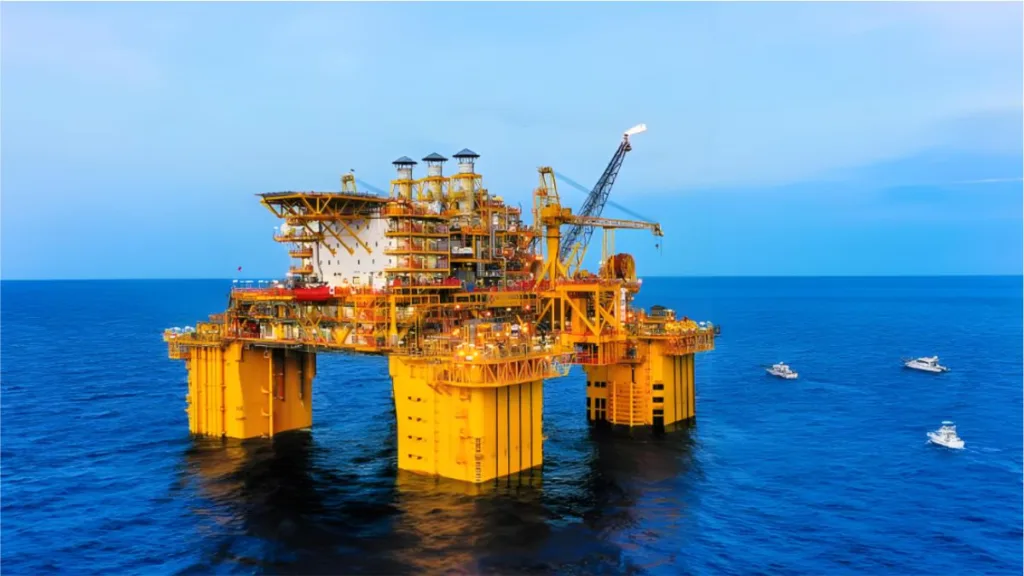
Marine Engineering – Insulator Against Seawater
In seawater, N08825 not only resists general corrosion but, thanks to its high nickel content, is completely immune to chloride stress corrosion cracking. It is suitable for desalination equipment, offshore platform piping, subsea pipelines, etc. Even in high-velocity seawater containing sand particles, it performs admirably.
Nuclear Power & Environmental Protection – Regular in Harsh Conditions
N08825 is used in nuclear fuel reprocessing (resisting radiation-induced stress corrosion), FGD system spray pipes, acidic wastewater treatment equipment, and more.
From sulfuric acid plants to subsea pipelines, from nuclear reactors to food factories – N08825’s application map has long outgrown the label of “sulfuric-acid-only alloy.”

Why Is “Half Seawater, Half Flame” an Understatement?
Returning to the opening question: in “half seawater, half flame” equipment, why does N08825 get to have it both ways?
Because it was never designed for just “two fronts” – it was designed for “all fronts.”
Seawater? Handles it. N08825 maintains a stable passive film in chloride solutions up to 100,000 ppm, with a PREN of 29–35.
Sulfuric acid? A piece of cake. Corrosion rate is only 1/15 to 1/20 that of 316L, and it withstands up to 60% concentration.
High temperature? No issue. Mechanical properties are stable up to 540°C, and tensile strength at 500°C remains above 550 MPa.
Low temperature? Even less of a concern. No ductile-to-brittle transition at –196°C.
Hydrogen sulfide? Immune. Meets NACE MR0175, threshold stress ≥90% of yield strength.
A true all-rounder never needs to “pick its environment” – the environment picks it, and it takes it all.
The “Swiss Army Knife” of Industry
N08825’s story is one of versatility.
It doesn’t strive to be the absolute best in any single niche – in high-temperature resistance, it falls short of some superalloys; in strong oxidizing acids, it yields to Hastelloy C-276.
But in terms of “overall capability” – N08825 has few peers.
From –196°C to +540°C, from sulfuric acid to seawater, from oxidizing acids to reducing acids, from chlorides to hydrogen sulfide – N08825 is not a “one-subject specialist” but an “all-round straight-A student.”
That is precisely why it is called the “Swiss Army knife of alloys.”
A Swiss Army knife can cut, shear, screw, open bottles – it does a bit of everything, and does it well.
N08825 can handle sulfuric acid, seawater, high heat, low temperatures, stress corrosion, pitting, crevice corrosion – it handles everything.
From Import to Domestic: N08825’s Chinese Story
N08825 is not some “faraway foreign novelty.”
China began developing iron‑nickel-based corrosion-resistant alloys in the early 1980s, including Alloy 825. At that time, limited by metallurgical equipment and industrial capability, products were confined to small-size bars and plates – limited variety, high cost, and restricted specifications.
But Chinese industry never stopped advancing.
Today, TISCO’s N08825 nickel-based alloy plates have been successfully delivered to internationally renowned pressure vessel manufacturers for Middle Eastern petroleum refining projects, marking the first batch supply of this material to overseas high-end markets. Domestic enterprises have also successfully replaced imports, supplying the first domestic 10-million-ton refinery project in Quanzhou – for high-pressure hydrogen service.
From “total import” to “bulk export” – N08825’s Chinese story is a microcosm of China’s high-end manufacturing catching up with world-class levels.
Within a single pipe, half is boiling sulfuric acid, half is icy seawater.
For ordinary materials, that is a “death sentence.”
For N08825 – it’s just another ordinary workday.
Because from the day it was born in the 1950s, N08825 was created to take on such “impossible missions.” Its five-layer armor system lets it switch freely between oxidizing and reducing environments; its wide temperature tolerance, from extreme cold to extreme heat, lets it walk calmly between ice and fire.
Half seawater, half flame – N08825 says: both ways, no problem at all.