
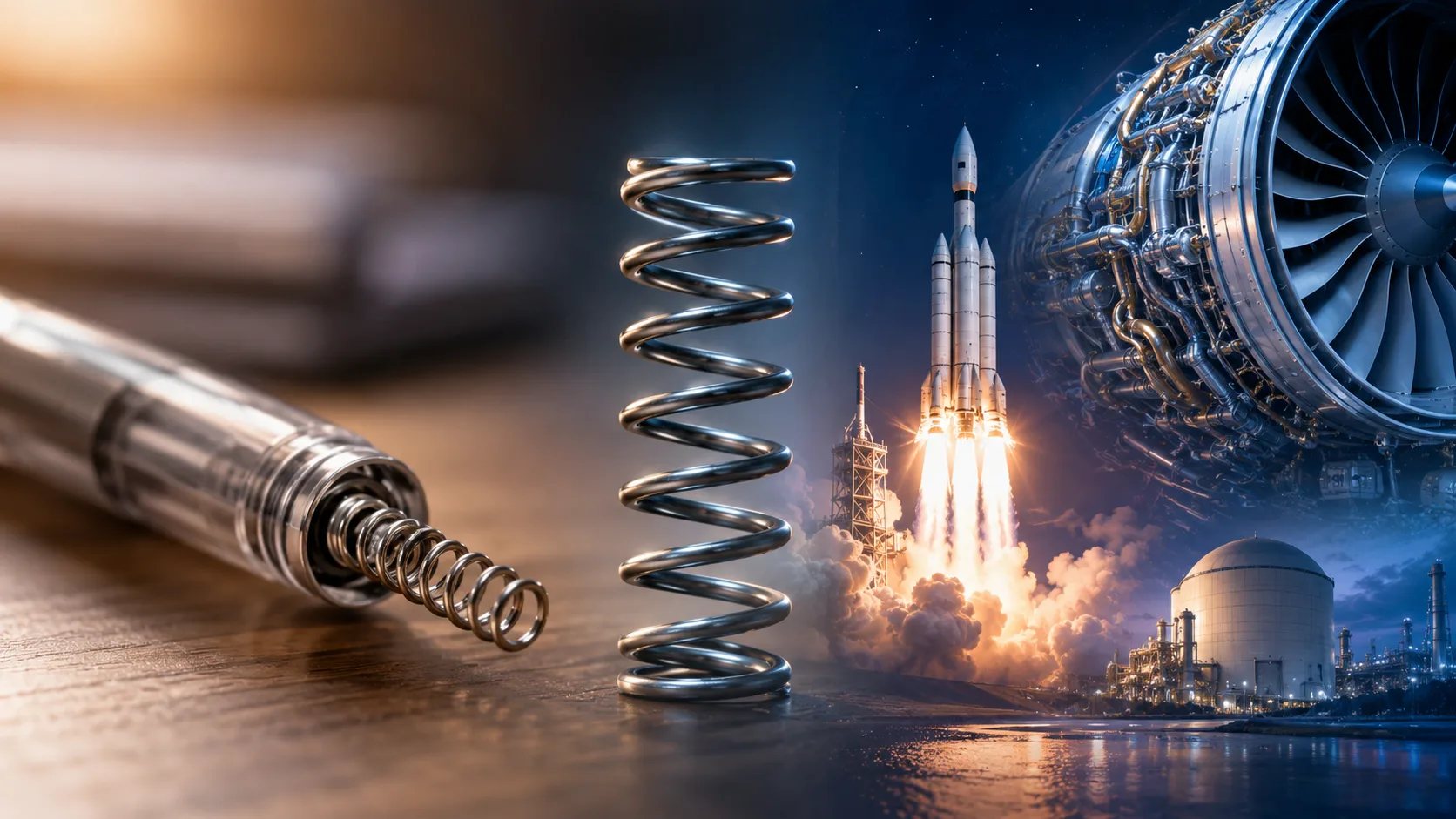
Introduction: The Hidden Connection Between Everyday Objects and Space Technology
Have you ever considered that the tiny spring beneath your fingertips in a ballpoint pen could share a remarkable relationship with the propulsion system of a rocket engine?
At first glance, the two seem to belong to entirely different worlds. One is an inexpensive everyday object that costs only a few dollars; the other is a highly sophisticated engineering system worth hundreds of millions. Yet both may rely on the same class of material technology.
The answer is Inconel X-750.
To be precise, this does not refer to the ordinary carbon-steel spring found in most retractable pens. Such springs would rapidly lose mechanical performance at elevated temperatures. Rather, Inconel X-750 appears in specialized high-performance spring systems and in critical components found within aerospace propulsion systems—the very technologies that enable humanity to reach space.
How does a seemingly simple spring evolve from a desktop component into a key element of rocket engineering?
The answer lies in the science of materials.
The Hierarchy of Springs: From Carbon Steel to Superalloys
Springs are among the simplest mechanical elements in engineering systems. Their operating principle is straightforward: they store and release energy through elastic deformation.
However, increasing performance requirements quickly transform a simple component into a demanding materials challenge.
Consumer-Level Springs: Ballpoint Pen Mechanisms
Inside a retractable ballpoint pen lies a small helical spring, typically manufactured from carbon steel wire or conventional stainless steel.
Its operating requirements are modest:
- Operation near room temperature
- Tens of thousands of loading cycles
- Minimal cost
- Basic durability
For such applications, ordinary spring materials are entirely sufficient.
Automotive Suspension Systems
Moving upward in performance requirements, automotive suspension springs encounter significantly more demanding conditions.
Materials commonly used include silicon-manganese spring steels such as 60Si2Mn and 55SiCrA, which can achieve tensile strengths exceeding 1274 MPa after heat treatment.
These materials must:
- Support vehicle weight
- Absorb road impacts
- Survive millions of cyclic loading events
Yet they possess an important limitation.
Beyond approximately 250°C, mechanical performance begins to degrade. At higher temperatures, the material softens and gradually loses elastic recovery capability.
Aerospace and Rocket Applications: Springs in Extreme Environments
At the highest level are springs operating within aircraft and rocket propulsion systems.
Their operating environments can be extraordinary:
- One side may contact liquid hydrogen at −253°C
- The opposite side may approach combustion environments above 800°C
This represents a temperature difference exceeding 1000°C.
Maintaining reliable performance under such conditions requires a material capable of resisting:
- Thermal shock
- High-temperature softening
- Stress relaxation
- Fatigue
- Fracture
Very few materials can satisfy these requirements.
One of them is Inconel X-750.
Inconel X-750: A Landmark Nickel-Based Superalloy
The name Inconel X-750 may sound like something from science fiction; in reality, it represents one of the most important developments in modern materials engineering.
The alloy was developed during the late 1940s by the International Nickel Company (INCO), during the early era of jet propulsion and emerging space technologies.
Engineers required a material capable of simultaneously providing:
- High-temperature strength
- Low-temperature toughness
- Corrosion resistance
- Oxidation resistance
- Long-term structural stability
Starting from the nickel-chromium-iron system used in Inconel 600, researchers introduced additional alloying elements including aluminum, titanium, and niobium.
The result was Inconel X-750.
Across international standards, the alloy appears under different designations:
- China: GH4145
- United States: UNS N07750
- Germany: W.Nr. 2.4669
- Japan: NCF750
Although the names differ, the underlying material remains the same.
Chemistry as Engineering: The Alloy Design Strategy
The composition of Inconel X-750 represents a carefully optimized balance of alloying elements.
Nickel (≥70%)
Nickel serves as the matrix material and provides:
- Face-centered cubic austenitic structure
- High-temperature stability
- Corrosion resistance
Nickel effectively forms the structural foundation of the alloy.
Chromium (14–17%)
Chromium forms a dense oxide layer, primarily chromium oxide (Cr₂O₃), which protects the alloy from oxidation and corrosion at temperatures approaching 980°C.
Iron (5–9%)
Iron contributes solid-solution strengthening while reducing material cost.
Aluminum and Titanium
These elements play a central role in strengthening.
During heat treatment they form nanoscale precipitates known as the γ′ phase.
Niobium and Tantalum
These elements further stabilize the strengthening structure and improve high-temperature performance.
Carbon and Trace Elements
Small amounts of carbon form carbides that pin grain boundaries and suppress undesirable deformation at elevated temperatures.
Additional trace elements provide fine microstructural control.
The Secret of Strength: γ′ Precipitation Strengthening
The remarkable properties of Inconel X-750 originate from one of the most important strengthening mechanisms in modern metallurgy:
γ′ precipitation strengthening.
The strengthening phase is approximately represented by:
Ni₃(Al,Ti,Nb)
A useful analogy is reinforced concrete.
The nickel matrix acts as the concrete, while nanoscale γ′ precipitates function as microscopic steel reinforcements distributed throughout the material.
These particles impede the movement of dislocations—the microscopic defects responsible for plastic deformation.
Restricting dislocation motion substantially increases strength.
Equally important, γ′ precipitates maintain coherent or semi-coherent interfaces with the surrounding matrix.
Consequently:
- Interfacial energy remains low
- Particle coarsening occurs slowly
- Strengthening effects remain stable over long service periods
This mechanism explains why the alloy retains excellent mechanical properties under extreme conditions.
Heat Treatment: Activating High Performance
Composition alone does not determine performance.
The alloy must undergo precisely controlled heat treatment.
Solution Treatment
The alloy is heated to approximately:
1095–1200°C
All alloying elements dissolve into the matrix before rapid cooling creates a supersaturated solid solution.
At this stage, the material remains relatively soft and workable.
Stabilization Treatment
Optional stabilization treatment at approximately:
840°C
allows controlled carbide precipitation at grain boundaries.
Aging Treatment
The final aging process occurs at approximately:
700–730°C
This stage initiates large-scale γ′ precipitation throughout the material.
The effect is dramatic.
Following complete heat treatment:
- Tensile strength: 1138–1379 MPa
- Yield strength: >1000 MPa
Compared with the solution-treated condition, strength may increase by more than 50%.
Applications: From Springs to Space Systems
The applications of Inconel X-750 span many of the most technologically demanding areas of modern industry.
High-Temperature Springs and Fasteners
Its most well-known application remains:
- Springs
- Bolts
- Retaining components
- Sealing elements
These components must maintain performance over decades without significant stress relaxation.
Aerospace Engines
Typical aerospace applications include:
- Turbine structures
- Springs
- Impellers
- Sealing rings
- Structural fasteners
Rocket Propulsion Systems
Rocket thrust chambers operate under some of the harshest thermal environments in engineering.
Combustion temperatures may exceed:
3000°C
while cryogenic fuel systems operate near:
−253°C
The resulting thermal stresses are severe.
Because of its resistance to thermal fatigue, oxidation, and high-temperature deformation, Inconel X-750 remains an important material choice in such environments.
Nuclear Power Systems
Within nuclear reactors, the alloy is used in:
- Internal structural components
- Springs
- Spacer grids
- Heat exchangers
- Fastening systems
These environments combine:
- High temperature
- High pressure
- Radiation exposure
- Neutron bombardment
Few materials can survive such conditions over long service lives.
The Miracle Beneath Your Fingertips
The next time you press a ballpoint pen, pause briefly and consider the small spring hidden inside.
Its distant technological relative may simultaneously be:
- protecting an aircraft engine at cruising altitude,
- supporting control systems within a nuclear reactor,
- or accompanying a rocket on its journey into space.
From an inexpensive pen on a desk to launch systems reaching beyond Earth’s atmosphere, materials technology connects seemingly unrelated worlds.
This is perhaps the most fascinating aspect of materials science:
The most ordinary objects often conceal the most advanced engineering achievements.
And sometimes, an entire technological story begins with something as simple as a spring.